Ayurvedic Approaches to Soothe Monsoon Insect Bites
⏱ 8 min read·Updated Aug 2026·0% read

Introduction
During the monsoon season, increased humidity and moisture create ideal conditions for insect activity and skin sensitivities, often leading to discomfort from bites and irritations. Traditional Ayurvedic remedies offer a holistic approach to support skin comfort and balance during this period. In Ayurveda, insect bites, known as Keeta Damsha or Mashaka Damsha (mosquito bites), are classified under Jangama Visha (animate poisons) and are meticulously described in classical texts such as the Sushruta Samhita and Charaka Samhita, detailing their symptoms and management.
Key Benefits
-
Supports a healthy inflammatory response
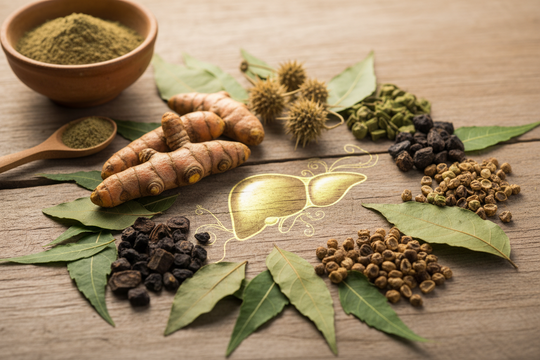
Monsoon humidity can aggravate Pitta dosha, leading to redness and burning sensations associated with insect bites. Herbs like Turmeric (Haridra), with its bitter (tikta) and pungent (katu) tastes, and heating (ushna) potency, traditionally support the body's natural inflammatory response. Research suggests curcuminoids in Turmeric may support this effect. -
Promotes comfortable skin and reduces itching
The dampness of monsoon can increase Kapha dosha, contributing to itching (kandu) and swelling (shopha). Neem (Azadirachta indica), known for its bitter (tikta) taste and cooling (shita virya) potency, is traditionally valued for its skin-soothing properties, which may help support relief from itching and irritation. -
Aids in skin cleansing and balance
During monsoon, skin can become prone to bacterial and fungal growth due to excess moisture. Aloe Vera (Kumari), with its cooling (shita virya) and sweet (madhura) taste, is traditionally applied to support skin cleansing and maintain its natural balance. Its properties may also help provide comfort in cases of mild irritation.
-
Supports natural insect deterrence
Certain Ayurvedic herbs are traditionally used to create an environment less appealing to insects. Neem oil, due to its bitter taste and pungent post-digestive effect (katu vipaka), is traditionally applied topically to exposed skin to help deter mosquitoes and other insects.
The Ayurvedic Perspective
In Ayurveda, insect bites and skin irritations during monsoon are primarily linked to the aggravation of Pitta and Kapha doshas. The increased humidity (kleda) and dampness of the rainy season naturally increase Kapha, leading to conditions like itching, swelling, and fungal growth. Simultaneously, the accumulated heat of the preceding summer, which is characteristic of Pitta, tends to manifest on the skin during monsoon as redness, burning sensations, and inflammatory responses. Classical texts like the Sushruta Samhita describe various types of Keeta Visha (insect poisons) and their doshic implications, noting that Vata-predominant bites cause pricking pain, Pitta-predominant bites lead to burning and redness, and Kapha-predominant bites result in mild pain and swelling.
Herbs traditionally used for monsoon skin support often possess specific Ayurvedic properties to counteract these doshic imbalances. Neem (Azadirachta indica) is renowned for its bitter (tikta) taste, cooling (shita virya) potency, and pungent (katu vipaka) post-digestive effect. Its light (laghu) and dry (ruksha) qualities help to balance excess Kapha and Pitta. Turmeric (Haridra) has pungent (katu) and bitter (tikta) tastes, a heating (ushna virya) potency, and a pungent (katu vipaka). Its dry (ruksha) and light (laghu) qualities are beneficial for Kapha, while its bitter taste helps balance Pitta. Aloe Vera (Kumari) is sweet (madhura), bitter (tikta), and astringent (kashaya) in taste, with a cooling (shita virya) potency and a sweet (madhura vipaka). Its unctuous (snigdha) and heavy (guru) qualities help to soothe Vata and Pitta. These herbs are often incorporated into traditional formulations (Agadas) mentioned in texts like Ashtanga Hridaya for their antitoxic and skin-supportive effects. For lifestyle topics, Dinacharya (daily routine) and Ritucharya (seasonal regimen) emphasize practices to maintain skin health, such as cleansing with decoctions of Neem or Triphala and avoiding prolonged dampness.
How to Use
For soothing monsoon insect bites and skin irritations, topical applications are often preferred. A paste made from Neem powder mixed with a small amount of water can be applied directly to the affected area, left for 10-20 minutes, then rinsed off. This can be done once or twice daily. Similarly, a paste of Turmeric powder and water, or a blend of Turmeric and Sandalwood powder, may be applied to support comfort and reduce redness. For a more cooling effect, fresh Aloe Vera gel can be applied directly to the skin.
Internally, consuming a tablespoon or two of fresh Aloe Vera juice on an empty stomach daily may help support skin purification. Always consult a qualified Ayurvedic practitioner or a registered doctor before starting any new herbal regimen, especially if you are pregnant, nursing, have an existing medical condition, or are taking other medications.
FAQs
Q: Why does skin irritation increase during the monsoon?
A: During the monsoon, heightened humidity and moisture create an environment conducive to fungal and bacterial proliferation on the skin, and can aggravate Pitta and Kapha doshas, leading to increased itching, rashes, and discomfort.
Q: Which Ayurvedic herbs are traditionally used for monsoon skin issues?
A: Herbs like Neem, Turmeric, and Aloe Vera are traditionally valued in Ayurveda for supporting skin health during monsoon due to their properties that help balance doshas and promote comfortable skin.
Q: Can I use Neem oil as an insect repellent during monsoon?
A: Yes, Neem oil is traditionally used as a natural insect repellent. Applying it to exposed skin may help deter mosquitoes and other insects during the monsoon season.
Q: How can I prevent insect bites and skin irritations in monsoon with Ayurveda?
A: Ayurvedic preventive measures include maintaining good hygiene, keeping skin dry, using herbal cleansers like Neem-based soaps, and applying natural insect deterrents like Neem oil. Adjusting diet to pacify Pitta and Kapha is also recommended.
Q: When should I consult a doctor for monsoon skin irritations?
A: It is always advisable to consult a qualified Ayurvedic practitioner or a registered doctor for severe or persistent insect bites, skin irritations, or any concerns, especially if symptoms worsen or do not resolve with home remedies.