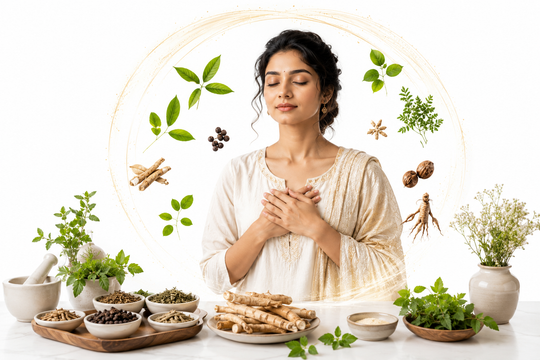
Shatavari for Women's Monsoon Wellness: An Ayurvedic Approach
⏱ 16 min read·Updated Aug 2026·0% read

Shatavari's Embrace: Supporting Women During Monsoon
Shatavari (Asparagus racemosus) is traditionally valued in Ayurveda for supporting women's health, particularly during the monsoon season when the body's digestive fire (Agni) naturally weakens and Vata and Pitta doshas can become imbalanced. This revered herb, often called the "Queen of Herbs," helps nourish the reproductive system, supports hormonal balance, and maintains overall vitality through its inherent cooling and rejuvenating properties. Its significance in Ayurvedic texts like the Charaka Samhita underscores its role as a primary Rasayana, or rejuvenative tonic, specifically for female physiological well-being across all life stages.
Key Benefits for Monsoon Wellness
- Supports hormonal balance: Shatavari is traditionally used to support the body's natural hormonal regulation throughout a woman's life, from menstrual cycles to menopausal transitions. Its phytoestrogenic compounds may help modulate estrogen activity, which is beneficial during periods of hormonal fluctuation commonly experienced due to seasonal shifts and lifestyle factors.
- Promotes healthy lactation: One of Shatavari's most celebrated traditional uses is as a galactagogue, meaning it is valued for supporting healthy breast milk production in nursing mothers. Research suggests that standardized Shatavari root extract may help increase milk volume and maternal satisfaction with breastfeeding. Studies have observed increased prolactin levels in mothers taking Shatavari, indicating its potential to support mammary tissue growth and milk synthesis.
- Supports comfortable, regular digestion: During the monsoon, weakened Agni can lead to digestive discomfort. Shatavari, with its unctuous and cooling qualities, is traditionally used to soothe irritated mucous membranes throughout the digestive tract. It may help support healthy digestion by balancing excess Pitta and alleviating dryness caused by aggravated Vata, contributing to comfortable bowel movements.
- Supports resilience to stress: As an adaptogenic herb, Shatavari is traditionally used to help the body adapt gracefully to various stressors. It may support a calm nervous system and steady energy levels, which are crucial during the monsoon season when environmental changes can sometimes contribute to feelings of fatigue or imbalance.
The Ayurvedic Perspective: Rasa, Virya, Vipaka, and Dosha Effects
In Ayurveda, Shatavari (Asparagus racemosus) is classified as a potent female Rasayana, meaning it deeply rejuvenates and nourishes. Its inherent properties are crucial for understanding its wide-ranging support for women's health, especially during the monsoon when Vata and Pitta doshas often become aggravated.
Shatavari's rasa (taste) is predominantly sweet (madhura) with a subtle bitter (tikta) undertone. Its virya (potency) is cooling (shita), and its vipaka (post-digestive effect) is sweet (madhura). These qualities contribute to its primary action of pacifying aggravated Pitta and Vata doshas, which tend to increase during the humid and damp monsoon season, often manifesting as heat, inflammation, dryness, or irregular bodily functions. The key gunas (qualities) associated with Shatavari are guru (heavy) and snigdha (unctuous or oily), which further enhance its nourishing and grounding effects, counteracting the light and dry qualities of Vata.
Classically, Shatavari is prominently featured in ancient Ayurvedic texts such as the Charaka Samhita and Ashtanga Hridaya. The Charaka Samhita categorizes it as a Balya (strength-promoting), Vrishya (reproductive tonic), and Stanyajanana (milk-increasing) herb. It is traditionally used to nourish Rasa Dhatu (plasma and lymph) and Shukra Dhatu (reproductive tissue), which are vital for overall vitality and reproductive wellness. For instance, in formulations like Phalaghrita, Shatavari is traditionally recommended to support conception and healthy pregnancy. The traditional anupana (vehicle) for Shatavari is often warm milk, honey, or ghee, which enhances its nourishing and ojas-building properties, making it particularly suitable for strengthening the body during the monsoon.
Optimal Usage During Monsoon
For women seeking to incorporate Shatavari into their monsoon wellness routine, the specific form and dosage can vary. Shatavari is commonly available as a churna (powder), capsules, or in medicated ghees. For general well-being and dosha balancing during the monsoon, a typical dosage of Shatavari powder ranges from 3-6 grams daily, often divided into two doses. This can be mixed with warm milk, water, or honey to enhance its palatability and efficacy. Alternatively, capsules containing 500-1000 mg of standardized extract can be taken once or twice daily.
The best timing for Shatavari intake is generally with food, either in the morning or early evening, to support gradual assimilation and consistent benefits. For lactation support, specifically, mixing 2-5 grams of powder into warm milk twice daily is a traditional practice. BodyWell Ayurveda's LACTOMAX - Ayurvedic Lactation Powder, which contains Shatavari, is a thoughtfully crafted option for supporting mothers during their breastfeeding journey. When considering such a supplement, it is prudent to start with a lower dose and gradually increase it while monitoring the body's response.
Individuals who are pregnant, breastfeeding (beyond lactation support), or on ongoing medication, particularly those with diabetes or taking diuretics, should consult a qualified Ayurvedic practitioner or a registered doctor before incorporating Shatavari into their regimen. While Ayurveda traditionally considers Shatavari safe during pregnancy, modern scientific research on its safety in this context is still developing. Those with known allergies to asparagus should also avoid Shatavari.
FAQs on Shatavari for Women's Monsoon Health
Q: Can Shatavari be taken throughout the entire monsoon season?
A: Yes, Shatavari can be traditionally taken throughout the monsoon season to support overall female well-being, particularly for balancing aggravated Vata and Pitta doshas. Consistent use helps maintain hormonal balance and digestive comfort during this humid period.
Q: What is the best anupana (vehicle) for Shatavari during monsoon?
A: For optimal benefits during the monsoon, Shatavari powder is traditionally recommended with warm milk, ghee, or honey. These anupanas enhance its nourishing and grounding qualities, helping to pacify Vata and Pitta.
Q: Are there any specific dietary considerations when taking Shatavari in monsoon?
A: While taking Shatavari, it is advisable to follow general Ayurvedic monsoon dietary guidelines, focusing on warm, cooked, and easily digestible foods. Avoiding excessively cold, heavy, or raw foods can further support Agni and enhance Shatavari's benefits.
Q: How long does it typically take to observe benefits from Shatavari?
A: Shatavari works gradually as a rejuvenative herb. Most individuals may begin to observe supportive benefits for hormonal balance, digestion, or lactation after consistent use for 4-8 weeks.
Q: Can men also use Shatavari during the monsoon?
A: While primarily known for women's health, men can also traditionally use Shatavari as a general adaptogen and reproductive tonic. Its cooling and nourishing properties can support overall vitality and stress resilience for men as well.